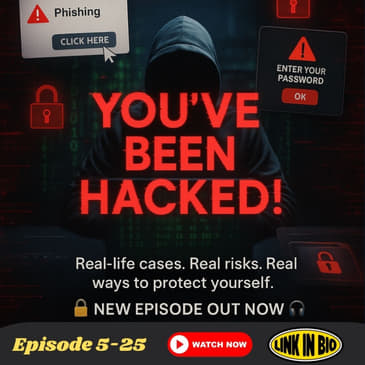
You’ve been hacked. Not maybe. Not soon. Right now—some part of your data is already in the hands of criminals.
In this eye-opening episode, Ryan breaks down the $10.5 trillion cybercrime boom that’s outpacing drug cartels—and explains why most hacks don’t happen with code... they happen with confidence tricks.
🎰 MGM Resorts lost $100M from one phone call
🗳️ UK election data leaked for 13 months—without anyone noticing
💊 A Florida clinic paid $200K in Bitcoin just to access patient records
We expose the rise of:
🤖 AI-designed scams (FraudGPT is real)
💸 Ransomware-as-a-Service
📲 Deepfake phone calls from “your kid” begging for help
Plus: What you can actually do to protect yourself—without becoming a digital prepper.
If you reuse passwords, ignore 2FA, or have a smart fridge… yeah, this episode is for you.
🔒 Knowledge is armor. Complacency is bait.
📤 Share this with the one friend still using “123456” as a password.
🎧 Listen now. Before it’s too late
Time Codes ⏱️/ Topics: 00:00 Hook – Why You Need to Hear This 00:35 You've Been Hacked: The Reality of Cyber Crime 01:29 The Dark Economy of Cyber Crime in 2025 04:35 Real-Life Cyber Crime Cases 06:41 Why Cyber Crime is Getting Worse 08:28 Protecting Yourself from Cyber Attacks 11:35 The Future of Cyber Security 13:28 Conclusion: Taking Action Against Cyber Threats
00:00:00
Cybercrime has become the most profitable criminal business in
00:00:05
the world, more profitable than drug trade, and you don't need
00:00:10
cartel anymore. You just need Wi-Fi and a
00:00:12
keyboard. Cybercrime is projected to cost
00:00:15
the world $10.5 trillion. That is trillion.
00:00:21
It's not just tech companies or governments getting hit either.
00:00:24
It's grandma. It's your dentist.
00:00:26
It's your local pizza shop. Cyber criminals aren't
00:00:30
outsmarting us. They're they're betting we won't
00:00:32
take 5 minutes to protect ourselves.
00:00:34
And they're usually right. Hey guys, what would you say if
00:00:38
I looked at you right now, straight into the camera and I
00:00:41
said you've been hacked? Not maybe, not someday, but
00:00:47
right now, this exact moment, some part of your digital
00:00:51
footprint is already sitting on a server in Belarus or floating
00:00:57
through a hacker forum on the dark web.
00:01:00
Your e-mail probably leaked, your password reused across 11
00:01:05
different accounts, your phone number probably tied to some
00:01:09
sketchy crypto scan by now. This isn't fear mongering, it's
00:01:14
just math. Cybercrime has become the most
00:01:18
profitable criminal business in the world, more profitable than
00:01:23
drug trade. And you don't need cartel
00:01:26
anymore. You just need Wi-Fi and a
00:01:28
keyboard. So today I want to dive into the
00:01:31
dark economy of cybercrime in 2025, how it works, why it's
00:01:36
growing faster than anyone can stop it, and what you can do to
00:01:42
stop being a sitting duck with a router.
00:01:45
I'm tackling this because I've been scammed.
00:01:48
Not necessarily to this extent, but it's happening a lot around
00:01:52
me and in this world. And it's something that needs to
00:01:56
be talked about. It needs to a lot of, a lot of
00:01:58
people don't have an interest in this.
00:02:00
So I'm going to give you the kind of the dumbed down version
00:02:03
of it in a sense, tell you some basics on on how to avoid it and
00:02:07
how to prevent it, how to how to be aware of it.
00:02:11
And it's just basic stuff. It's, it's nothing major.
00:02:15
It's just an awareness and without having to dig in too
00:02:19
deep and listen to these cyber geeks talk.
00:02:24
I can't stand it. It's a lot to listen to
00:02:26
sometimes. So I'm going to give you the
00:02:30
different version of that, the easier version to to hear and
00:02:34
talk about and it'll be short and quick and to the point.
00:02:37
So let's roll the dark side of the Internet.
00:02:41
Let's start with the big terrifying number.
00:02:44
According to Cybersecurity Ventures, cybercrime is
00:02:48
projected to cost the world $10.5 trillion.
00:02:53
That is trillion. It's not just tech companies or
00:02:56
governments getting hit either. It's grandma.
00:02:58
It's your dentist. It's your local pizza shop.
00:03:02
In 2024, ransomware payouts totaled $1.1 billion.
00:03:09
And that's just the money that we know about.
00:03:12
The victims included a county government that couldn't issue
00:03:16
marriage license for weeks, a school district that had to shut
00:03:19
down for days, a small HVAC business forced to lay off staff
00:03:24
after their systems were wiped. In most of these attacks, they
00:03:29
didn't involve hacking some impenetrable firewall.
00:03:33
Over 70% of breaches happened because of social engineering,
00:03:38
which is the term I just learned.
00:03:40
It's a fancy term for tricking people into handing over the
00:03:43
keys. No lock picking required for
00:03:45
these people. A phishing e-mail that looks
00:03:48
like your bank. Fake login screen for your
00:03:51
Netflix account. You've seen them.
00:03:53
They're all over your emails. They're all over everything you
00:03:56
do. Any advertisements, text
00:03:58
messages, WhatsApp. All the time.
00:04:02
They try and scare you. Yeah.
00:04:03
Facebook messages on on Meta. You know your accounts in danger
00:04:07
of being shut down. You better.
00:04:09
You better click this link. Yeah, It has nothing to do with
00:04:12
Meta or Facebook. And don't be wrong.
00:04:15
I mean, I I'm sitting here going, man, I need to take care
00:04:16
of this. And a lot of people do and click
00:04:19
it and it's basically opening a door.
00:04:21
But now you can further deep fake voicemails pretending to be
00:04:25
your boss saying, hey, can you wire me 10 in cash to this
00:04:30
vendor real quick? Not going to work.
00:04:33
So let's talk about a few actual cases.
00:04:36
How about The MGM Resorts in 2023?
00:04:40
MGM Resorts got wrecked. I'm talking slot machines down,
00:04:45
guests locked out of hotel rooms, apps offline, the works.
00:04:50
What happened? Hackers found an employee on
00:04:52
LinkedIn, just a mid level IT staffer for MGM.
00:04:57
They called the help desk after getting all this person's
00:05:00
information, pretended to be him and said hey, I lost my
00:05:04
credentials, can you reset my login and the help desk did it.
00:05:11
That 5 minute phone call cost the company over $100 million.
00:05:15
Case number 2, the UK Electoral Commission.
00:05:19
In the UK, their Electoral Commission, the people in charge
00:05:23
of protecting democracy, was breached.
00:05:27
Over 40 million voter records were assessed.
00:05:30
Names, addresses, contact details, all exposed.
00:05:35
Here's the kicker. They didn't realize it happened
00:05:38
the 13 months. By the time they noticed, the
00:05:42
data was long gone. No ransom, no warning, just
00:05:47
gone. Case number 3, Florida Medical
00:05:51
Clinic, a small independent medical clinic in Florida,
00:05:55
nothing fancy, just a neighborhood operation, was hit
00:05:58
with ransomware. Suddenly they couldn't access
00:06:00
patient records, appointment schedules, prescriptions,
00:06:04
billing. The hackers demanded $200 in
00:06:09
Bitcoin or else they delete everything and leak patient
00:06:13
data. Honestly, I'm surprised that it
00:06:16
was only $200 they paid because what choice did they
00:06:21
have? If you run a clinic and you lose
00:06:23
access to patient histories, you're fucked.
00:06:27
None of these were high tech Mission Impossible break
00:06:30
insurance. They were confidence tricks,
00:06:33
manipulation. Cybercrime now plays out like a
00:06:35
con movie, not a hacking thriller.
00:06:40
So why is it getting worse? There are three big reasons #1
00:06:45
automation. Hackers don't sit around writing
00:06:47
viruses anymore. They download tool kits.
00:06:51
Ransomware as a service is a thing.
00:06:54
Think Uber, but for criminals. You pay a subscription, you run
00:06:59
a few scripts, and the ransomware campaign basically
00:07:02
runs itself. You don't need to know how to
00:07:04
code. You only need to know how to
00:07:06
Google. How do I hack a small business?
00:07:09
That's scary. The next one that's scary that
00:07:13
I've talked about recently is AI.
00:07:15
There are now versions of ChatGPT designed specifically
00:07:21
for cybercrime. They're called things like fraud
00:07:25
GPT and worm GPT. If you ask it.
00:07:30
If you say something like write me a a fake invoice that looks
00:07:34
real or create a phishing e-mail that bypasses Gmail filters, it
00:07:39
does and fast. To me, that's a huge problem.
00:07:43
I don't, I don't understand why it's allowed.
00:07:45
I don't know how people can't monitor it better, but all I'm
00:07:49
doing is I'm giving you the information.
00:07:51
Hopefully that can be fixed sometime soon.
00:07:55
And the third one is human laziness.
00:07:57
This one's on us and I and I'm I'm included in this.
00:08:01
People reuse passwords across 20 different websites and they
00:08:06
don't change it up. They don't turn on their growing
00:08:11
in popularity 2 factor authentication.
00:08:16
They click allow all cookies on sites that look like they were
00:08:18
made in 2007 by a 10 year old. Cybercriminals aren't
00:08:23
outsmarting us. They're they're betting we won't
00:08:25
take 5 minutes to protect ourselves, and they're usually
00:08:28
right. So how do we protect ourselves?
00:08:30
Well, I'll make it simple for you.
00:08:33
For individuals, use a password manager.
00:08:36
They're out there now. They're built into your
00:08:38
computers. Stop using your birthday or your
00:08:42
dogs name. These tools generate long random
00:08:45
passwords. You've all seen them and they
00:08:48
remember them now so that you don't have to.
00:08:50
And that's the key. I mean, the, the point is, is
00:08:53
that nobody wants to write down 37 characters, uppercase,
00:08:57
lowercase numbers, symbols for every different password you
00:09:01
have. And, and we all know we have
00:09:03
like 50 and I'm not exaggerating when it comes to your everyday
00:09:07
life. So having these passwords,
00:09:11
having them remembered is key and turn on the two factor
00:09:16
authentication. Just do it, especially on the
00:09:19
important counts, your emails, social media stuff, the bank,
00:09:24
the two FA. It means you need, you need to
00:09:26
know something. You need something you know,
00:09:29
like your password and something you have like a phone code
00:09:34
somewhere that only you can access for them.
00:09:37
And then this is an interesting one.
00:09:39
Freeze your credit if you're not using it.
00:09:42
It stops the scammers from opening loans in your name.
00:09:45
If if you don't need it then don't let it just sit open.
00:09:47
Basically it takes 10 minutes and it costs nothing to do.
00:09:52
That's a big one. This is the hard one.
00:09:55
Avoid public Wi-Fi. If you must use it then you can
00:10:00
run AVPN, a virtual private network.
00:10:04
Free Wi-Fi is also free access for everyone, including the
00:10:09
criminals. So use AVPN and again, I'm, I'm
00:10:12
just kind of learning all this myself over the last couple of
00:10:15
months and, and that should help.
00:10:19
And be suspicious of urgency. If somebody says something, they
00:10:24
need it quickly. Real companies don't threaten
00:10:27
you. They don't want, they're going
00:10:28
to threaten you to shut your account down or do whatever in
00:10:31
30 minutes. That's the scammers playbook.
00:10:34
You do it quickly, they're in, they're out and they've
00:10:37
succeeded. So for businesses, enforce multi
00:10:41
factor authentication in FA across the board.
00:10:46
That's basically 2FA with extra layers. e-mail plus password
00:10:51
plus phone app or biometric. And train your team.
00:10:55
Regular phishing tests actually work.
00:10:58
Your people need to know how to spot fake CEO emails and dodgy
00:11:04
links. Back up the data offline and
00:11:09
encrypted. If ransomware hits, you don't
00:11:11
want to be negotiating with someone using a Pepe the Frog
00:11:15
avatar and limit access. Not every intern needs access to
00:11:21
the payroll data, but fewer people with admin rights the
00:11:25
safer your systems will be. You're not aiming to be
00:11:28
unhackable, you're aiming to be less hackable than the next guy.
00:11:33
And that's the truth. So what the what does the future
00:11:37
look like? Here's where it gets disturbing.
00:11:40
Scammers are using deep fake video calls to impersonate CEOs
00:11:45
and get finance teams to wire money, Phone scams that mimic
00:11:50
your child's exact voice, crying and asking for help, crypto
00:11:55
wallets emptied in seconds via a rogue browser extensions and
00:12:00
smart homes. A total mess.
00:12:03
Your fridge, your baby monitor, even your doorbell Cam.
00:12:06
They're all connected to the Internet and they're vulnerable.
00:12:11
Internet of Things. IoT devices are the low hanging
00:12:15
fruit of the cybersecurity world.
00:12:17
Once hacked, they become bots. Now your thermostat's helping
00:12:21
launch ADDOS attack in Singapore.
00:12:26
You wanted everything smart. Hackers say thanks for the
00:12:30
upgrade. Don't panic, but don't be dumb.
00:12:36
Let's be real, you're not going to delete Instagram and go live
00:12:40
in a cabin somewhere. So the goal is to disappear.
00:12:43
The goal is to stop handing out your data like party favors.
00:12:47
Just like you lock your front door at night, it's time to lock
00:12:51
your digital life as well. Small steps equals massive
00:12:56
protection. Update your passwords, turn on
00:13:01
authentication, stop clicking links from
00:13:04
amazon_support62942@e.mail.ru that's Not Amazon I, PROMISE
00:13:14
we're. Living in a digital battlefield
00:13:16
you. Don't need to be a hacker you.
00:13:18
Just need to stop acting like a tourist in a danger zone
00:13:22
information. Is armor action, power,
00:13:26
complacency, that's. How you lose if this episode
00:13:30
made you sweat a little bit. It was short, quick to the
00:13:34
point. I didn't I'm not trying to bore
00:13:36
anybody. But again, these are things we
00:13:39
need to be aware of when thinking about this.
00:13:42
The only thing I had in mind was, you know, why are all these
00:13:46
two step authentications coming out?
00:13:48
Why is this? Why is this?
00:13:49
And and a close, close friend of mine who who works in IT.
00:13:55
So this is kind of scary and, and they're, they're the ones in
00:13:58
the know. So I, I started looking into
00:14:01
this and, and I'm sitting here going man, and I'm learning and
00:14:05
these are the things, the things I gave you today.
00:14:09
It's all you really need to do. And so if people would just take
00:14:13
10 minutes here, 15 minutes or however long it's been and
00:14:16
listen and go, man, the next time that password comes up
00:14:19
that's got 37 digits, maybe I'll use a, a password manager and
00:14:23
I'll, and I'll use that versus, you know, Fluffy in 1996 and,
00:14:28
and see what happens, you know, so if you sweat a little bit
00:14:32
listening to this and go, oh man, good.
00:14:34
Go fix your password. Do it like this share, send it
00:14:39
to some person that's using 123456 on their iPad password.
00:14:45
So this was a little bit different than what I usually
00:14:50
do, but it's important. So I hope you enjoyed it, I hope
00:14:53
I taught you something and I hope you use it in day-to-day
00:14:55
life. Spread the word, tell everybody,
00:14:58
send it over, give me some likes, some reviews, follows,
00:15:02
whatever, all the good stuff. Every bit helps.
00:15:06
See you next time guys, love you.